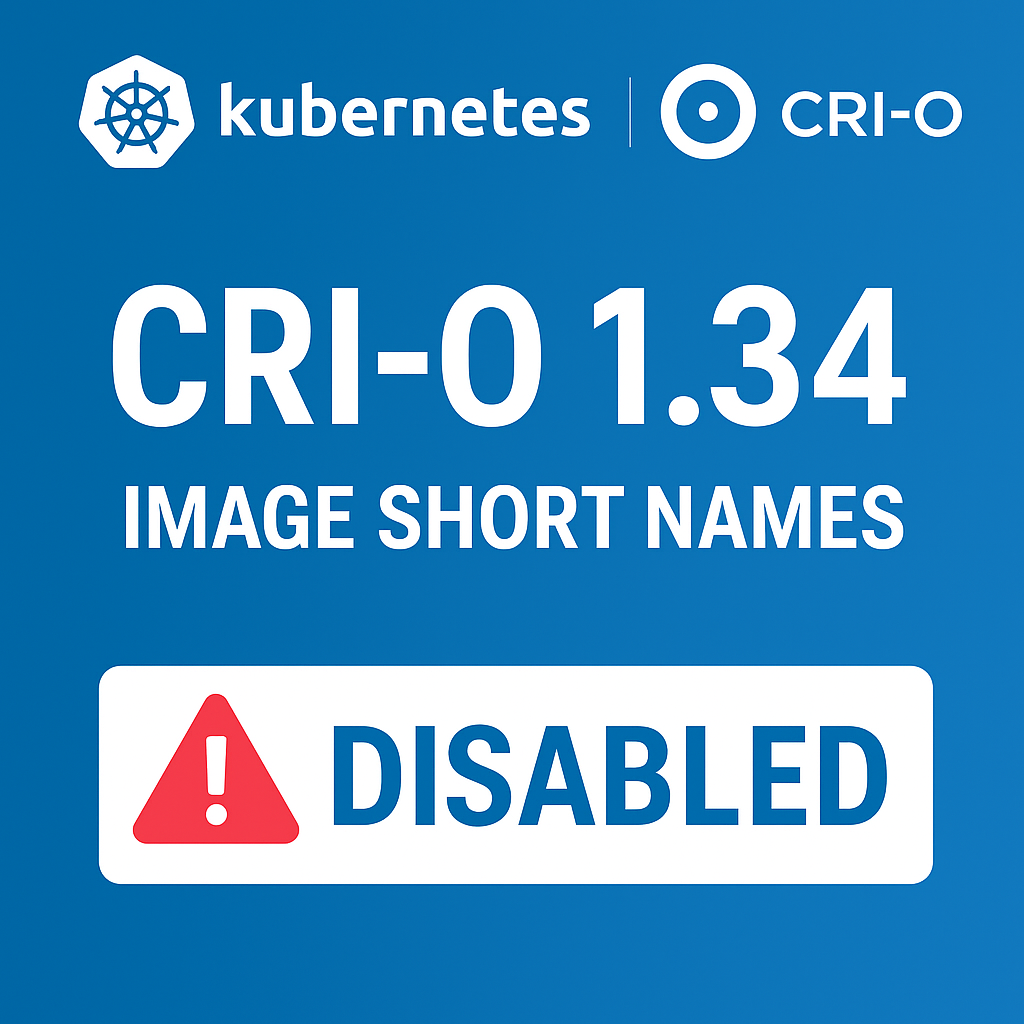
CRI-O Users — Be Careful When Moving to Kubernetes 1.34
The Kubernetes ecosystem continues to evolve rapidly, and CRI-O users need to stay alert when upgrading to Kubernetes 1.34. A major change in CRI-O 1.34 affects how container images are pulled — a small configuration difference that can lead to large-scale deployment failures if not handled properly.
The Change: Image Short Names Are Now Disabled
In CRI-O 1.34, image short names are disabled by default. That means an image reference such as: image: nginx
will no longer automatically pull from Docker Hub (docker.io/library/nginx). CRI-O now treats this name as ambiguous and refuses to pull it.
The correct approach is to specify the fully qualified image name, for example: image: docker.io/library/nginx
This ensures CRI-O knows exactly where to fetch the image.
Why Did CRI-O Make This Change?
CRI-O, the lightweight container runtime built by Red Hat, now checks multiple default registries — most notably docker.io and quay.io.
If the same image name (like nginx) exists in both registries, CRI-O cannot determine which one to use, resulting in a failed image pull.
By disabling short names, CRI-O enforces deterministic and secure image sourcing, aligning with Red Hat’s policy to promote Quay.io as the preferred container registry.
This change also improves security and traceability, helping prevent unintentional image pulls from untrusted or unexpected registries.
If You Need to Revert (Not Recommended)
For testing or backward compatibility, you can re-enable short name behavior by creating a drop-in configuration:
File:/etc/crio/crio.conf.d/shortnames.conf
[crio.image] short_name_mode = “disabled”
However, Red Hat and the CRI-O maintainers strongly recommend avoiding this unless absolutely necessary.
What You Should Do Before Upgrading
Before moving your clusters to Kubernetes 1.34, perform the following steps:
Review all Kubernetes manifests – Check every image: field and replace short names with full registry paths.
Update Helm charts and CI/CD pipelines – Ensure all templates and automation scripts reference fully qualified image names.
Audit third-party charts – Many community Helm charts still use short names; update them before production rollout.
Validate the upgrade in a staging environment – Deploy test workloads to ensure there are no unexpected image pull failures.
A Note from the Field
While setting up Kubernetes 1.34 in my R&D lab, I noticed several pull errors related to CRI-O’s new short name behavior.
The fix was straightforward — using full image paths — but the lesson was clear: small configuration changes can cause major deployment disruptions if overlooked.
I’ve already observed upstream projects like Helm Charts and Operators pushing pull requests to fix this issue. This reinforces how important it is to standardize image naming conventions early.
Final Thoughts
The CRI-O 1.34 update is another step toward improving security, predictability, and transparency in Kubernetes environments.
Although it may require a bit of manifest cleanup, the benefits — fewer ambiguities, better image control, and improved compliance — are well worth it.
Before your next cluster upgrade, take the time to:
Usefully qualified image names
VerifyHelm values and manifests
Testimage pulls in staging
Stay ahead of the change and keep your container environment stable and secure.
Expert in VMware | Red Hat| Backup | Storage Solutions
Author of this blog Shaokat Ullaha is professional in IT filed, Specialist in VMware, Cloud Solutions, DevOps, Backup and Digester Recovery
#Categories
#Follow Me
SUBSCRIBE TO RACHEL MOOR BLOG
#Recent Post
#Leave A Comment
Subscribe To Newsletter
Get Notification of each & every new blogs through your e-mail
This is a blog platform where I share my personal experiences and insights, encouraging others to share theirs as well so we can learn from each other and grow together